Why Passport Photos Get Rejected — and Which Faults Count
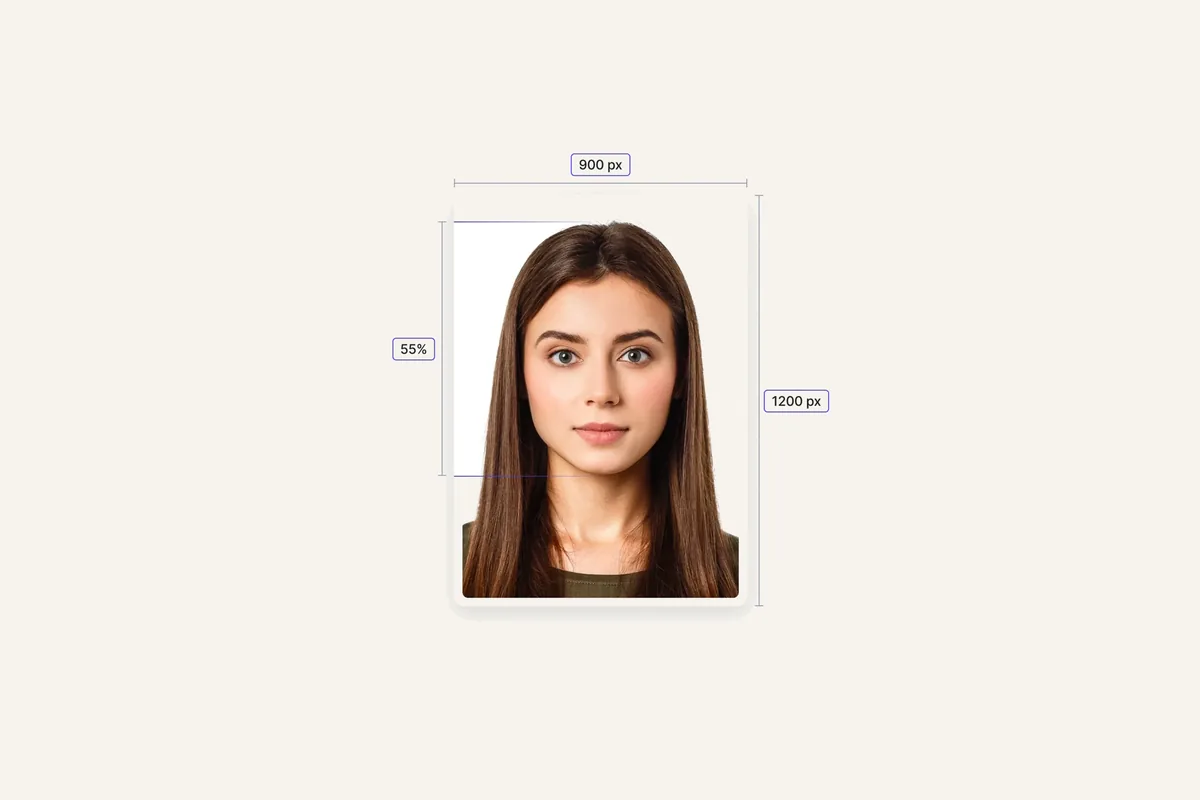
Most rejections come from proportions, not from the camera. Which faults are measurable, which need a human eye, and how to check yours before submitting.
Most rejected photos are not bad photographs. They are correctly exposed, properly focused pictures that fail on proportion — the head is the wrong size within the frame, or the eyes sit at the wrong height.
That matters because proportion is fixable without retaking anything, and because it is the one class of fault a machine can actually measure.

Faults a machine can measure
These are geometric or statistical properties of the image file. They can be checked objectively, and the photo checker measures them against the specification for the country you select.
Head height. The distance from the crown of the head to the chin, as a proportion of the frame height. Specifications vary — around 70–80% of the frame is common for the 35 × 45 mm format, while the 51 × 51 mm format used by some countries sits far lower, around 50–69%. Getting this wrong is the single most common cause of rejection.
Note what is being measured: crown to chin, not the face. Face-detection boxes exclude the forehead and hair, which is why a photo can "look right" and still be out of specification.
Eye line. How far the eyes sit from the bottom edge, as a proportion of the frame. Specified separately from head height by several authorities.
Frame proportions. 35 × 45 mm, 51 × 51 mm and others are not interchangeable. A square photo cropped to a 35 × 45 frame changes the head proportion at the same time.
Resolution. Below a stated pixel floor, the file is rejected regardless of how it looks on screen. Enlarging a small file does not add detail — it adds visible blocks.
Background uniformity and tone. Measurable as colour variance across the area that is not the subject. A patterned wall, a visible edge, or a shadow gradient all register.
Exposure and sharpness. Under-exposure and blur are measurable as statistical properties of the pixels.
Head position in frame. Horizontal centring, whether the crown is cut off at the top edge, whether the shoulders are included.
Faults that need a human
No automated tool can confirm these, and any tool that claims to is overstating itself:
- Expression. Neutral, mouth closed, both eyes open and visible.
- Glasses. Glare on the lens, frames obscuring the eyes, tinted lenses. Several authorities now prefer no glasses at all.
- Head covering. Rules differ, and the exceptions are generally religious or medical. The face must usually be visible from the bottom of the chin to the top of the forehead.
- Recency. Most authorities require a photo taken within the last six months. Nothing in the file proves when it was taken.
- Retouching. Smoothing, filters and beauty modes are grounds for rejection, and phone cameras often apply them by default.
- Identity. Whether the photo is a true likeness of the applicant.
This is why our checker returns some items as "review this yourself" rather than passing them. A tool that returns all green on a photo it cannot fully assess is giving false confidence.
What a checker can and cannot promise
An automated check establishes that a photo is not obviously wrong on measurable grounds. It cannot establish that a photo will be accepted. The issuing authority is the only body that accepts or rejects, and many run a human review after their own automated check passes.
Treat a clean result as "worth submitting", not as "approved".
Before you submit
- 1. Select the right country in the checker. The specification differs by issuing authority, and some countries do not publish one — in that case the tool shows the international (ICAO) baseline and labels it as not nationally verified rather than presenting it as that country's rule.
- 2. Check the measurable items. If the head height is out of range, you may not need a new photo — recropping can fix it.
- 3. Recrop rather than retake where the original has enough resolution. The photo cropper locks the frame to the country's ratio and runs entirely in your browser; no image is uploaded anywhere.
- 4. Review the human items yourself against the authority's own published examples — expression, glasses, head covering, how recent it is.
- 5. Turn off beauty mode before retaking, if you retake.
The practical shortcut
If your photo was rejected and you were not told why, check the proportions first. Head height and frame ratio account for a large share of rejections, and both are visible in seconds once you measure them rather than eyeball them.
If the proportions are correct and it was still rejected, the cause is almost certainly in the human list — most often expression, glare on glasses, or a shadow on the background that is subtle on screen and obvious in print.
 Travel Assistant